Despite Eating Less, I'm Not Losing Weight
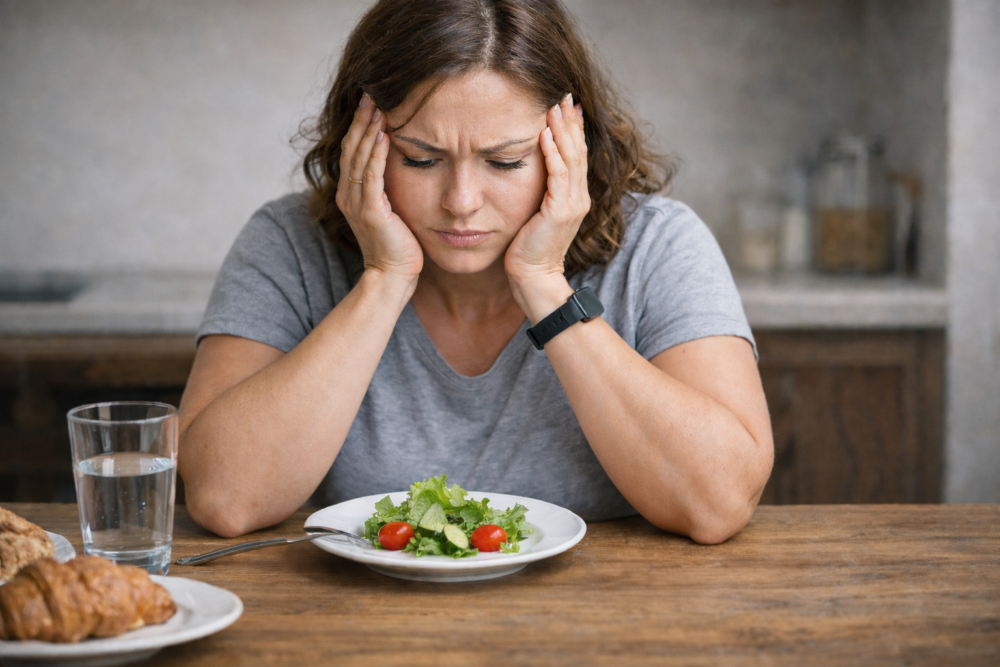
Many women in perimenopause know this feeling: they count calories, skip breakfast, eat nothing but salad in the evening — and the scale still won't budge, or even creeps up. What used to work reliably suddenly doesn't anymore. That's rarely a lack of discipline; it's hormonal changes that often begin years before the cycle itself becomes irregular.
During this phase the entire hormone balance shifts: estrogen swings more sharply, progesterone declines, insulin sensitivity changes, and cortisol reacts faster to stress. All of that directly affects metabolism and blood sugar — which is exactly where the misunderstanding starts, that it's about willpower, when it's really about changing biology.
If calorie intake is cut further in this situation, the body reads that as a stress signal and switches into a kind of survival mode: basal metabolic rate drops, fat is stored more around the belly, muscle breaks down, cravings increase, and sleep gets worse. This so-called metabolic adaptation means an approach that used to work now backfires — and many women wrongly read that as personal failure.
A central, often-overlooked factor here is blood sugar: even in healthy women without diabetes, it becomes more sensitive during perimenopause. Sharp swings trigger more insulin release, which in turn slows fat burning, drives cravings, and disrupts sleep — a cycle that eating even less tends to worsen rather than resolve. Women who have made this shift instead report eating more and still losing weight, because it wasn't the amount but the stability of their blood sugar that made the difference.
gsoond's approach therefore isn't about restriction, but about enough protein, healthy fats, well-chosen carbohydrates, movement after meals, and stress reduction to achieve stable glucose curves. Continuous glucose monitoring (CGM) isn't there to police you — it's there to build understanding: it shows in real time how your own body responds to meals, stress, or lack of sleep, and makes visible that perimenopause often calls for more stability, not less food.